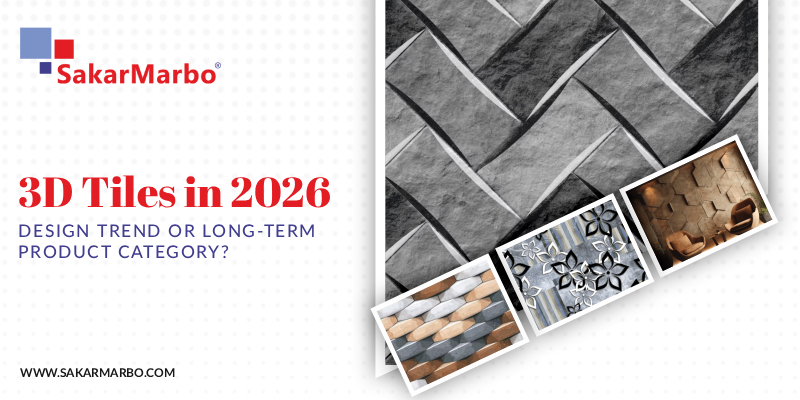
3D Tiles in 2026: Design Trend or Long-Term Product Category?
7 February 2026
It was evident in the tile market around the world by the end of 2025: customers were no longer seeking variety just for the sake of it. Importers and resellers began asking more realistic questions – Which products can be depended upon? What do you consider to be shelf space-worthy categories? What tiles will enable us to stand out, but not risk more?
It is at this point that 3D tiles had to take a new turn in the discussion.
What was initially a design-oriented product has slowly transformed itself into a serious business category. By 2026, whether 3D tiles are attractive or not is not a question; the question is whether they should be included in importer and reseller portfolios on a long-term basis.
How 3D Tiles Moved Beyond Design Appeal
At first, 3D tiles were placed as showcase products- applied selectively in living rooms, lobbies or signature walls. They played a visual role mostly. But in recent years, the behaviour of the market has shifted. More buyers are increasingly embracing textured surfaces that provide depth without necessarily using bold colour or heavy patterns. This has changed the 3D tiles to be more versatile in both residential and light commercial areas. This is a major change in the case of a tile manufacturer or tile exporter. Goods previously deemed as decorative are now being tested in consistency, scale and recurrent demand.
Why Importers Are Paying Attention in 2026
The 2026 importers are working with narrower catalogues and more focus. Many are no longer focusing on increasing the SKUs indefinitely, and instead, they are focusing on products that create differentiation yet are not complex.
3D tiles are suitable for this need due to the following reasons:
They make a visual appeal without the need for constant change of design.
The 3D patterns are neutral and can be used in various markets.
They assist resellers in creating high-quality segments which are not high risk.
To a tiles company that offers its products to global markets, 3D tiles are not as much of a trend product as they are a strategic addition now.
The Role of 3D Tiles Inside Showrooms
The ability to perform on a showroom level is one of the largest factors driving 3D tiles to new levels of relevance over time.
3D tiles:
Captures attention at a higher rate compared to flat surfaces.
Request the customers to pause, feel and interact.
Help resellers persuade visually, not orally.
Often, one 3D tile display is the centre of a whole wall-tile discourse. This ensures that 3D tiles are not only a design choice, but also a sales tool.
Manufacturing Consistency Is the Deciding Factor
Although design might attract initial attention, manufacturing quality will define how long a product stays in the market. To be a long-term category, 3D tiles will need to meet the requirements for core wall tiles. This involves batch-to-batch consistency of depth and finish, dependability of packing such that breakage is minimised during transit, and repeat orders, which are supported by scalability in production capacity. Even the most beautiful designs cannot maintain the demand without these fundamentals.
Here, the role of the experienced tile suppliers in Gujarat is important. Gujarat-based manufacturing centres have built the infrastructure that would enable them to balance between design innovation and production discipline- something that importers are increasingly focusing on. When a tiles exporter is able to sell 3D tiles of a quality that is predictable and is reliable in providing next-time supply, the buyers are much more assured of returning and investing in the category in the long run.
Are 3D Tiles Replacing Flat Wall Tiles?
The answer here is no, and that is the reason why 3D tiles perform. They are not designed to substitute the regular wall tiles but to support them. The majority of residential and commercial construction projects still use flat tiles on larger surfaces with a random application of 3D tiles in order to add texture, depth, and contrast. This discriminatory use continues to make the spaces visually active but not cluttered up.
This is the perfect balance as far as business is concerned. Flat tiles are still used to generate volume, and 3D tiles are used to add margin and differentiation. To resellers, the combination would assist in driving the average value of the order without introducing extra complexity to inventory control.
Wrap-Up
A clear vision rather than extravagance will be rewarded in the tile market in 2026. The products that stand the test of time are those that are rich in visual appeal and reliable in terms of their operations.
The 3D tiles have passed the boundary between innovation and necessity, not to all surfaces, but to the appropriate spaces and to the appropriate purchasers. A tile manufacturer, tile exporter or tile supplier in Gujarat, such as SakarMarbo, provide texture, value and differentiation without sacrificing consistency.
Get Price List
100% Response Rate
We generally respond within 24 hours.
For better quotations, include:
- A self-introduction
- Special requests, if any