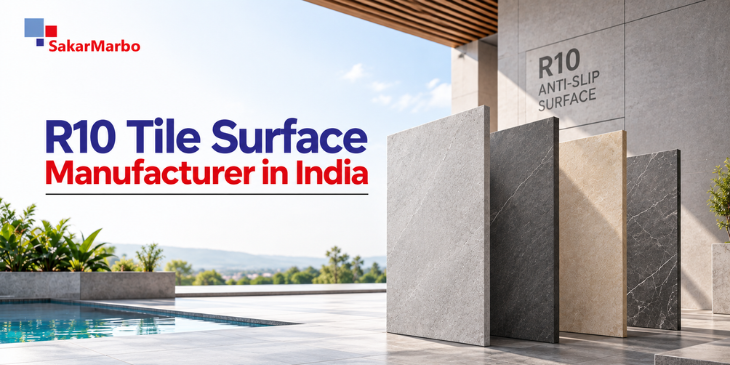
Appearance is just one of the considerations when selecting the flooring in areas that contain moisture. The surface should also offer an appropriate grip. The DIN 51130 ramp-test system categorizes R10 tiles as having moderate slip resistance, ranging from 10° to 19° of an angle. R-rating is based on the Rampentest in Germany, which measures the slip resistance of a tile on an inclined surface that is coated with oil. The test angle is slowly increased until the specified slip condition is attained. The higher the number (R9 to R13), the more slippery the surface is. This makes R10 Anti-skid tiles a viable choice for many indoor locations that have moisture control requirements and even a little spillage. They are especially used in outdoor areas where slip resistance is important and in washroom areas. They are also used in garden walkway paths for outdoor use.
How Is the R10 Slip Rating Tested?
R10 is not a classification based on the feel of the tile. It is derived from a controlled test.
The DIN 51130 ramp test involves pouring oil on the tile surface and placing a test operator with standardized safety footwear on the surface while the ramp angle is increased. The R classification is related to the angle of the slip. It is significant for R10 tile surface manufacturers in India. To be considered R10, the surface needs to be clearly textured. The finished tile should meet the appropriate performance during testing.
What Makes the Surface Anti-Skid?
These tiles require glazing and a correct temperature of 1210 degrees Celsius in the kiln to get the correct surface. The texture of the surface is carefully designed to provide more grip between the shoe and the tile. This texture is not overly coarse but is normally controlled in R10 tiles.
This provides a balance of slip resistance, appearance, and cleanability. If the surface is too rough, it can trap more dirt and could need more maintenance, and if it is overly smooth, it may not grip as well when wet.
Therefore, manufacturing control is important. The surface texture of glaze can affect its performance, and this is influenced by the formulation, application, and firing.
Where Are R10 Tiles Used?
R10 Floor Tiles are often used in areas that have moisture and/or spills in the interior. They include bathrooms, kitchens, entrances, cafés, restaurants, hotels and light commercial spaces.
They can be especially helpful when buyers wish more surface traction but do not wish to go to the much rougher surfaces used in higher slip-resistance applications.
But R10 shouldn’t be classified as appropriate for all wet or outdoor uses. The choice of the right tile also relies on water absorption, conditions during installation, exposure and local standards as well as the project’s requirements.
How Do R10 Tiles Compare with Other Ratings?
The R rating range is between R9 and R13. R9 gives the lowest level of ramp-test slip resistance and R10 gives a moderate level. R11, R12 and R13 are increasing levels of classification.
This doesn’t necessarily indicate that the maximum rating is the best. The choice of a tile should be based on the use it will be put into.
R10 Porcelain Tiles can be used in indoor residential and light commercial applications to offer a compromise between surface traction and usability. Higher classifications may be needed in more challenging areas.
Why Is Special Glaze Important in R10 Tile Manufacturing?
To make an R10 surface, you must do more than just scratch a finished tile. The desired surface morphology can be achieved by using specially developed glaze systems in the glaze production process.
The glaze must give a controlled texture and should have the right colour, finish and appearance. The firing temperatures also affect the development of the glaze on the surface of the tile.
This is where the skills of an R10 Tiles Manufacturer come into play. Standardising glaze preparation, application, and firing procedures will ensure all glaze batches have similar surface properties.
What Should Buyers Check Before Ordering R10 Tiles?
Importers and distributors should look beyond the words “R10 anti-skid.” They are required to verify the test standard, test result, water absorption, dimensions, thickness, surface finish, and usage.
Flatness and dimensional accuracy should also be checked for large-format tiles. If the tiles are being delivered for a commercial or export project, the buyer should ask for technical datasheets and relevant test documentation.
This technical information should be easily available from a reliable Anti Skid Tiles Manufacturer in India.
Why Choose an R10 Tile Surface Manufacturer in India?
Modern flooring requires anti-skid performance to complement design. An experienced R10 Tile Surface Manufacturer in India can combine controlled glaze technology, engineered surface texture, and precision manufacturing to produce tiles suited to different applications.
R10 surfaces can be developed in a variety of formats – 60×60 cm, 60×120 cm, and 80×160 cm – for residential, light commercial, and hospitality projects.
What is important is the simple fact that R10 is not a rough surface. It has been proven to have a slip-resistance classification with controlled surface engineering. Main tiles are available in a natural sandstone look for outdoor use and are very popular in European countries.
Get Price List
100% Response Rate
We generally respond within 24 hours.
For better quotations, include:
- A self-introduction
- Special requests, if any