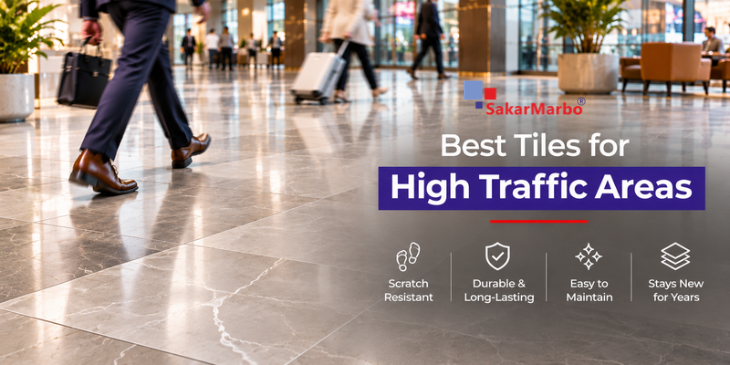
Some floors see hundreds of people every day. A mall corridor. A hotel lobby. A hospital waiting room. A shop entrance. A tile that looks fine in a bedroom may not last long here. Picking the best tiles for high traffic areas takes more than choosing a nice design.
At SakarMarbo, we make vitrified, porcelain tiles and supply importers, resellers and project buyers in 60+ countries. When buyers ask us for high traffic floor tiles, these are the things we check first.
Start with the tile body
Vitrified tiles have a dense body. They soak up very little water. Fully vitrified tiles absorb 0.5% or less. They are hard and strong, and that is the reason most commercial floor tiles now are vitrified or porcelain.
Still, two vitrified tiles can act very differently. The big question is how deep the design goes.
Double charge vitrified tiles
A double charge tile has two layers of colour pressed together. The design layer is about 3 to 4 mm thick. If the top wears a bit, the design is still there below it. Offices, showrooms and schools use double charge vitrified tiles a lot for this reason.
Full body vitrified tiles
In full body vitrified tiles, the colour goes all the way through. A chip or a deep scratch shows the same colour underneath. Factories and heavy commercial floors usually go for these.
Glazed tiles and PEI rating
GVT and PGVT tiles have the design on a glaze layer on top. You get lovely marble and stone looks this way. With glazed tiles, always look at the PEI rating. Their rating tells you how much wear the glaze can take. PEI rating tiles are tested only for glaze wear. Slip resistance and water absorption are separate checks.
Matt or glossy?
Glossy tiles look nice on day one. Put them in a busy shop though, and within a few weeks you start seeing scratches and dust marks. When it rains, people walk in with wet shoes and the floor near the door gets slippery.
For busy places we usually tell buyers to go with matt or textured tiles. They don’t show wear so much and you don’t slip on them easily. Near the entrance or a wash area, take anti skid floor tiles, and ask your supplier what slip rating the tile has.
Outdoor and vehicle areas
A parking area or driveway has a harder life than a living room floor. Cars and bikes drive over it every day, and it sits in the rain and sun all year. Normal indoor tiles crack or wear out quickly there. For these places we have parking tiles. They are thicker and stronger, so they can take the weight of a vehicle. Like most heavy duty floor tiles, the top is rough, which helps tyres and shoes grip even when the ground is wet.
Colour and size matter too
On a busy floor, pure white shows every footprint and deep black shows the dust. A mid-tone like warm grey or beige, or a tile with some pattern, hides most of it. Go for a slightly darker grout too, since light grout turns grey quickly.
Bigger tiles mean fewer joints to clean. But they need a level floor, a fitter who knows large formats and proper tile adhesive, not plain cement. For heavy commercial floors, 600×600 mm and 600×1200 mm are the usual sizes.
Installation is half the job
A strong tile can still crack if it is laid badly. In busy areas, hollow spots under the tile often cause cracks. The base must be level, and the adhesive should cover the full back of the tile. Expansion joints also need to be left where required. And no tile will last if heavy things keep falling on it.
What SakarMarbo offers
As a vitrified tiles manufacturer in India, SakarMarbo makes double charge tiles, GVT, PGVT, digital glazed tiles and parking tiles. We have tiles in matt and glossy finishes. We are ISO and CE certified, and most of our production goes to export markets.
If you are planning a project with busy floors, tell us the type of space, the expected foot traffic and the sizes you need. Our team will suggest the right tiles and share prices.
Get Price List
100% Response Rate
We generally respond within 24 hours.
For better quotations, include:
- A self-introduction
- Special requests, if any