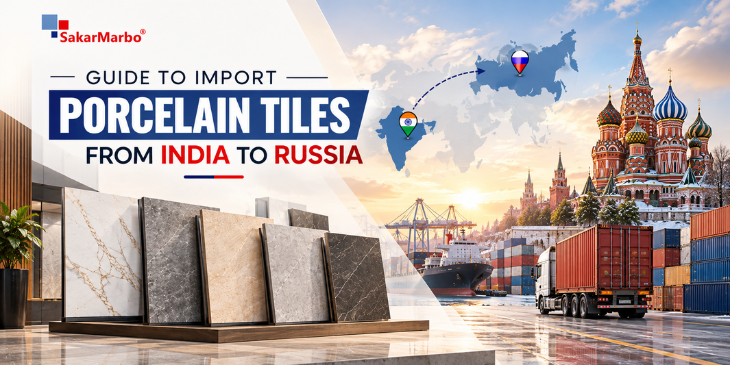
Guide to Import Porcelain Tiles from India to Russia
29 September 2026
India has become a source for international buyers looking for porcelain tiles and Russia is one of the main markets where Indian tile exporters have built a strong presence. For an importer buying Indian Porcelain Tiles, it is not just about comparing factory prices. It involves important steps that must be carefully managed before placing a large order.
1. Finding the Right Porcelain Tile Supplier in India
The first step is to look for a porcelain tile supplier in India. This involves selecting the manufacturer or exporter who can provide the product in a consistent manner.
Russian importers should consider the size, thickness, finish, use, water absorption, and quantity of the tiles before talking about price.
For orders or special projects, it’s best to approve a physical sample first. This assists in verifying the colour, texture, grade, and precise dimension and assures that there is no element of surprise in the manufacturing process.
Technical information and test reports should be supplied by the supplier for the tiles. Packaging is also of great significance. Tiles should be packed in export-quality cartons on pallets with corner protection and be correctly loaded into containers where they will not be damaged during transport. The above points should be negotiated with the supplier prior to shipment.
The terms of the business should also be clearly defined. Typically both parties reach an agreement about an Incoterm (FOB, CFR, or CIF) in order to allocate costs of transport and insurance. This will help prevent confusion when the shipment is underway.
2. Shipping Porcelain Tiles from India to Russia: Ports and Costs
Once the supplier and product are confirmed, the next step for Porcelain Tiles Importer in Russia is planning how to move the tiles from India to Russia. The choice of port matters a lot. Russian importers must pick a port based on where their warehouse, distribution center, or project site is located. Some major Russian ports and their UN/LOCODE codes include:
Novorossiysk—RU NVS (RUNVS)
Saint Petersburg—RU LED (RULED)
Ust-Luga—RU ULU (RUULU)
Vladivostok—RU VVO (RUVVO)
The codes are part of a system of UN/LOCODE codes which are used globally for trade and shipping documents. The Russian buyer shouldn’t solely consider ocean freight cost when selecting a port. Rather they should assess the landed cost, that is, all costs from the Indian factory to the final destination in Russia.
A basic formula for landed cost looks like this:
Product Cost + Inland Transport within India + Export/Port Charges + Ocean Freight + Insurance + Russian Port Charges. Customs Duty + Import VAT + Customs Clearance + Inland Delivery = Estimated Landed Cost. keep in mind all these for your next Porcelain Tiles Import from India.
The customs duty depends on the EAEU TN VED classification. Porcelain tiles fall under heading 6907. If the water absorption is 0.5% or less the product fits into category 6907.21. The importer must double-check the actual code for their specific tile type. Using a code from another shipment could lead to delays or fines. Import VAT is also a factor. As of January 1, 2026, the standard rate in Russia is 22%. However, the exact amount owed depends on the customs value and current rules. So it’s smart to check with a customs broker to get accurate figures.
Because of all these costs, Russian buyers should compare suppliers using the landed cost per m², not just the FOB or factory price. This gives a picture of what each option really costs.
3. Russian Customs, GOST, and Documents to Check Before Shipment
One of the typical mistakes is to think any shipment of goods can require a GOST certificate. This isn’t always the case. The conformity path will vary according to the product and regulations. The importer should make sure to seek the advice of the supplier or customs expert on the required paperwork, such as a certificate, declaration or other. In addition, the buyer should check with a Russian customs broker the TN VED code, customs value and all required documents. These are usually required documents:
– Commercial invoice
– Packing list
– Sales contract
– Bill of lading
– Certificate of origin
– Product technical specification
– Test reports
– Conformity documents
– Insurance papers if needed
All these documents must match the shipment. For example, the product description, size, number of cartons, weight, and pallet count must be consistent across every paper. A mismatch can cause delays at customs.
It’s also helpful for the importer to keep the approved sample and technical sheet on file. This makes repeat orders easier, especially when matching shade, calibre and finish is essential for consistency.
Final Takeaway
In the end importing porcelain tiles from India to Russia goes better when the buyer thinks through every detail ahead of time. Calculating the landed cost, completing compliance tasks early, selecting the right supplier, choosing a suitable Russian port, confirming the correct customs code, understanding taxes, preparing proper documents, and verifying product conformity—all of these things should be checked before the container ever leaves India.
If a manufacturer provides reliable technical information, high quality, robust export packing, and transparent commercial terms, the process can be smoother for the Russian buyers and distributors. This builds trust. Leads to long-term business relationships. SakarMarbo is the leading Porcelain Tiles manufacturer in India.
Get Price List
100% Response Rate
We generally respond within 24 hours.
For better quotations, include:
- A self-introduction
- Special requests, if any